

Table of Contents
Why Explore Unconventional Paris?
Getting an overall picture of a major city is often a difficult task when visiting as a foreigner. Usually, due to limited time, we focus on one aspect, one neighborhood or one moment, and tend to generalize based on that experience.
Paris is no exception to the rule. We could enter the overwhelming Louvre and decide that Paris is a big old museum. We could stay near the Eiffel Tower and figure that both the architecture and the Parisians look classy, but very homogeneous! Or roam the streets of the trendy Saint-Germain and conclude too quickly that the Parisian is mostly a Caucasian person, smoking and drinking wine…

Now that I’ve said that, I can picture many of you thinking: “Of course, I would love to explore the lesser-known side of Paris, but just the idea of it makes me feel overwhelmed!”
This is where Paris B-sides comes into play…
In the following chapters, I will try to give you an overall idea of what you discover when you let museums behind and venture in neighborhoods with a more local atmosphere.
Discover Not One but Many Paris
Paris is known throughout the world for its architecture, its cultural influence, and quite simply a certain art de vivre. However, while retaining a certain truth, clichés reflect only part of a complex reality, and are often stuck in the past.
My take is that Paris has always been diverse, full of contrasts, and its less advertised aspects really deserve to be discovered!
Bourgeois Paris vs Paris of the Faubourgs
Many outer arrondissements of the current configuration were not part of Paris before 1860 when they were forcibly incorporated by Prefect Haussmann during the reign of Napoleon III.
These were rural villages or bigger towns with their own specificity: local traditions, crafts and market gardening, specific origins of immigration and sometimes even certain geological features. All of these contributed to creating a strong sense of belonging among the locals to their faubourg—contraction of faux and bourg which translates as fake borough—the closest equivalent of today’s suburb.
Opposition to the bourgeoisie who lived in the bourg—the “official” city, to put it simply— was also reinforced by the existence of various bulwarks separating the town and the outskirts over the centuries, whether for military or fiscal reasons. Obviously, living behind a wall fueled resentment among peasants, and later the working class, who already struggled to make a living.
Fortunately for us, the fact that most of the outlying neighborhoods had a soil rich in groundwater or high-quality building stone saved them from destruction. As a result, most have managed to retain their identity ever since. It can still be heard that neighborhoods such as Belleville, Montmartre, Butte aux Cailles or the lesser known Petit Montrouge embody the essence of the real Paris, or at least a more social and human Paris!

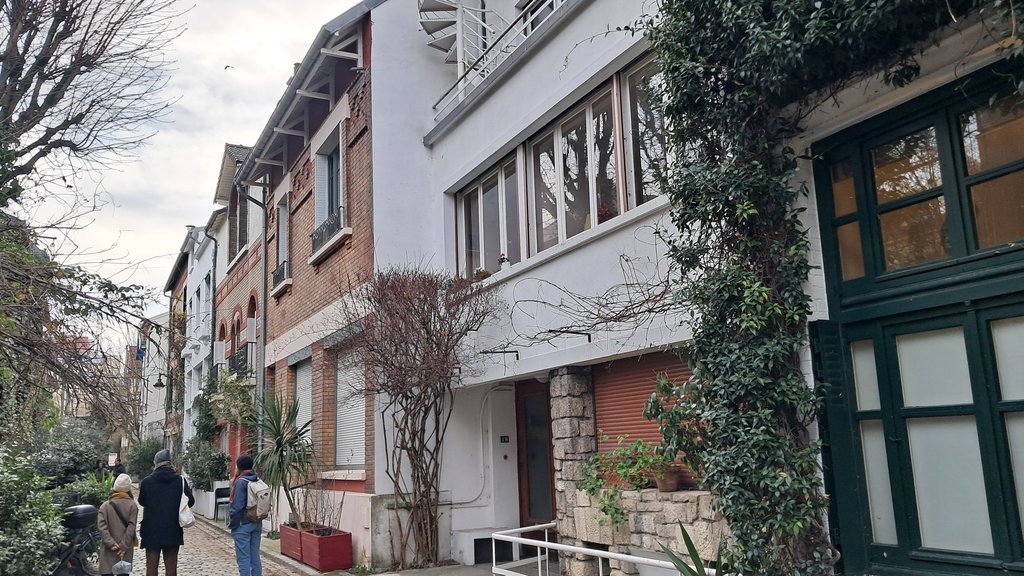
Thriving through Arts and Crafts in Paris
Of course, even today, Paris would not be Paris if art was not at the center of its daily life. Whether traditional or modern, arts and crafts are omnipresent throughout the city.
This aspect is evident when strolling through the two-century-old Covered Passages, said to be the first shopping arcades in the world.
An even better way to discover a variety of crafts is to visit the Arts & Crafts studios scattered throughout the old working class neighborhoods.


Paris also offers many possibilities of immersion in an artistic environment. First by showcasing the historical heritage of the country—both real estate and savoir-faire—during national events such as Heritage Days or The European Days of Crafts and Creativity. Second by offering a dense network of art galleries, foundations and concept stores, scattered all over the city.
Finally, a fact often overlooked when thinking about art in Paris, is that the city demonstrates a real taste for digital art. New technologies are at the core of cultural venues such as Atelier des Lumières or Centquatre, during the many Sound & Light shows in churches or parks, and even in the now trendy immersive themed restaurants.
Open Mind and Dynamism Are the Watchwords
Over the past two decades, the city has really invested in its future. Decision-makers have been focusing on topical issues such as transportation—think of the amazing Grand Paris Express project— housing, inclusion or accessibility.
City has no shortage of examples illustrating its dynamism. Among them, the very modern park of the Batignolles district, the Petite Ceinture in the North and its many vibrant cultural venues, the cultural development of the banks of the Canal de l’Ourcq, and many others where I hope to take you in the future.
Another very interesting aspect is the now systematic transitory occupation of derelict buildings awaiting their conversion by artistic, cultural and social projects. This has given birth to a myriad of hybrid third places, which drastically enriched the social life of Parisians of all generations.
Cherry on top for those who needed proof that miracles do exist, Paris has really opened up internationally lately and locals started to speak English… Can you believe that?

Towards a Greener and More Sustainable Life
Jardins à la Française… or à l’Anglaise!
From the kings era, Parisians have been enjoying iconic gardens à la Française like Luxembourg or Tuileries. However the underlying idea of what should be a garden back then was very strict: all trees perfectly trimmed, a geometrical layout, gravel paths and numerous sculptures.
Later, in the mid-1800s, the Haussmann renovation under Napoleon III gave birth to green jewels à l’anglaise. These parks have a more natural feel and can be considered more relaxing, with their large lawns and ancestral trees. Some great examples are Buttes Chaumont and Montsouris parks or much larger ones such as Bois de Vincennes and Bois de Boulogne.


Redevelopment of Derelict Areas
Fast forward to the turn of the last century, it has been decided to bring nature back into the heart of the city by taking advantage of derelict sites. It started in the 1990s with the creation of the Coulée Verte, a 4 km continuous green promenade on a former elevated railway. It is said that it greatly inspired New York’s High Line 15 years later.
Lately, since we entered the post-COVID era, this is the Petite Ceinture and its green potential that caught the interest of the city’s decision-makers. Still owned by the the national railway company but leased to the city, it is in fact a complete loop of railway tracks within Paris made available, 32 km long! Each year, new sections are converted into promenades, the South Petite Ceinture being one of the best examples of urban wilderness.

Go Green in Paris with Community Gardens and Urban Farms
At an even more local level, the community gardens a.k.a. jardins partagés and the urban farms are flourishing throughout the city and beyond. And this is to the delight of young and old alike, nature lovers, or simply people looking to socialize.
Paris Gastronomy Rhymes with Variety, Ethnicity and Creativity
Very much like the art scene, the local food scene has been witnessing both a revival of traditional French food and a wave of talented new chefs drawing inspiration from all corners of the globe.


Traditional Bouillons and Bistros
On the traditional side, we can cite recent openings of new bouillons like Bouillon Pigalle or Bouillon du Coq. And if you’re still on a quest for the Madeleine de Proust effect, rest assured, old-fashioned Parisian restaurants are still very much alive.
Find Food from Around the World…
Furthermore, ethnic gastronomy from Maghreb, West Africa, Vietnam, South India or Eastern Europe is doing well. Not to forget the world-wide famous cuisines from Italy, Japan, Korea, China or Lebanon of course.
…But Make Way for the New French Cuisine!
On the contemporary side, young chefs on the French neo-bistro scene can be roughly divided into two categories. Those who break the rules of traditional French cuisine in order to reinvent it, and those who embrace a more international idea of cooking to offer refined fusion cuisine.
Still Many Challenges to Overcome
Finally, I couldn’t end this review without admitting that while showing proof of a real dynamism, the city still faces structural, social and political issues, and sometimes linger on the edge of two opposite paths: conservatism and liberalism.

High Population Density as a Legacy
Paris has been very densely populated for centuries due to practical reasons. Its expansion was constrained by the need to protect itself from invaders thus the presence of a surrounding wall for most of its lifetime. The current reminder of the last fortification location is the circular highway commonly known as le Périphérique, that still marks the administrative limit between Paris and its suburbs.
Consequences of the narrowness of the area between the walls were many: craft and industry pollution, fast circulation of diseases, dirtiness of the streets, lack of greenery…
Thankfully most of these have improved nowadays, but Paris—in its official limits excluding the suburbs—remains the city with the highest density of population in the whole western world!
Complex Urban Planning
Besides that, the city of Paris and the surrounding region of Île-de-France often disagree on urban planning policies. The worldwide Cars versus Bikes opposition and the need for an extensive subway network in the suburbs have come back to the forefront lately. We can also cite the constant need for affordable housing, whether subsidized in the public sector or rent-controlled in the private sector.
The populations affected are students, low-income households, and, increasingly, the middle class, in the current difficult economic climate.
Constant Social and Political Concerns
In a worldwide troubled time, Paris is also on the front line to deal with the climate refugee crisis, homelessness and drug addiction that sometimes come along, and of course heated debates on the evolution—regression sometimes—of norms and customs in the society.
Politically, Paris is and always has been very divided. We could argue that it reflects perfectly the sociology of the city as a whole and that it might benefit the political debate to have two strongly opinionated sides. However the threat of being swayed by populism is growing strong, and defenders of basic human rights such as freedom and equality are on alert to counter any emerging fascism.
Threat of Food Standardization?
Let’s come back to gastronomy, to end with a lighter topic.
Both restaurant chains, local or international, and takeaways are gaining influence in central arrondissements. In the capital of the country where la pause déjeûner used to be sacred, I’ll leave it up to you to decide whether this represents an overall net benefit for the local food scene in all its diversity…
Unconventional Paris is Always a Good Idea
I guess a blog post cannot tell too much—without being such a bore—but I hope that now you can sense why, when designing my tours, I always try to keep in mind this golden rule: get off the beaten track as much as possible, to really feel the soul of the city!
To paraphrase a famous line from a movie starring Audrey Hepburn, I would consider my mission accomplished on the day my visitors come to the following conclusion:
Unconventional Paris is Always a Good Idea.— You, I hope.
Share the post on:
